
The village of Cucuron is undoubtedly one of the most beautiful villages in Vaucluse, a true gem to be discovered at your own pace, and an essential stop on any visit to South Luberon. Ideally located near Vaugines and Ansouis, the village of Cucuron is a stunning, quintessential Provençal village with timeless charm. Take the time to enjoy an ice cream by its vast lake, to stroll through its lanes lined with beautiful 17th- and 18th-century house façades, or to watch the rooftops blush at sunset from the Saint Michel keep.

The Bassin de l’Étang

The must-see spot in Cucuron is the Bassin de l’Étang, a vast lake at the heart of the village, lined with majestic plane trees, most of which were planted in 1813, just after the fall of the Empire. This unique spot, both refreshing and soothing, once served as a water reserve for the many flour mills located downstream. The lake is fed by gravity channels from springs tapped in the Luberon mountains.
First mentioned in 1403 in the municipal archives, this lake was for many years a key component of the village’s hydraulic system. It played a central role in agriculture and local crafts. It has been altered over time: its stone facing and banks were reinforced in the 19th century. Listed in 1954 as a picturesque site, the lake is now a place for gatherings and events. It serves as a natural backdrop for numerous film shoots and hosts summer festivities.
The Saint Michel Keep

Rising proudly above the village, like a stone guardian frozen in time, the Saint Michel Keep stands as one of the last remaining witnesses of the feudal castle of Cucuron. This impressive vestige, dating back to the 11th century, was once the stronghold of the powerful Reillanne-Valence family, before passing into the hands of the lords of Oraison. Gradually abandoned around the middle of the 17th century, the building slowly faded into obscurity, until its ruins were sold to a private individual in 1791, and later acquired by the municipality.
Today, only a truncated tower remains, accompanied by a staircase turret added at the end of the 16th century, bearing witness to the many alterations made over the centuries. Visitors enter through a doorway crowned with an elegant ogee arch. Upstairs, they discover a vaulted room carved directly into the rock. Now used for temporary exhibitions, this room invites you on a true journey through time.
In the past, a second level housed an identical room, now converted into a terrace (closed to the public for safety reasons), from where the panoramic view takes in the entire Cucuron area: the majestic Luberon mountain range to the north, the hills of Cadenet to the south-west, the village of Ansouis and its château to the south, and of course the red rooftops and the belfry of Cucuron, all overlooked by the silhouette of the Notre-Dame de Beaulieu church.
Notre Dame de Beaulieu Church

Majestically perched on a hilltop, away from the bustle of the winding streets, the Notre-Dame de Beaulieu Church has watched over Cucuron since the 13th century. Its name, which literally means ‘beautiful view’, is well deserved: from its forecourt, the view stretches across the ochre rooftops of the village and the plain of South Luberon.
Built from 1250 to replace the former Saint-Michel Church, which had become too small, this parish church is a fine example of southern Gothic architecture, with surviving Romanesque elements, particularly in the nave. The building was altered up until the 17th century, giving it a fascinatingly eclectic character. Listed as a Historic Monument in 1840, it features a single nave with a rib-vaulted ceiling, illuminated by understated yet luminous stained-glass windows.
Inside, the monumental organ immediately catches the eye. Built between 1786 and 1788 by Pierre Duges, a renowned organ builder, it was restored several times during the 20th century. Its carved wooden case is listed in the Inventory of Historic Monuments, and it is still used today during summer concerts, adding a spiritual dimension to evenings in Cucuron.
The three bells, cast in 1767, 1837 and 1881 respectively, still mark the rhythm of village life. The bell tower, with its imposing yet understated silhouette, once served as a landmark for travellers crossing the valley.
The surrounding area, older than the current village centre, retains a timeless atmosphere. Small, thick-walled houses nestle here, bearing witness to centuries gone by. The church, which has been at the heart of spiritual and social life for generations, remains today a place of reflection and history—an absolute must-visit for anyone wishing to immerse themselves in the Provençal spirit.
La Chapelle de l’Ermitage

This small building was originally a pilgrimage sanctuary, an annex of the parish, mentioned in several wills as early as 1292. At the start of the 17th century, the building was maintained by a confraternity who added a bell tower in 1602, a hermitage in 1613/1614, and a new nave between 1614 and 1620. The site was regularly maintained and inhabited by one or more hermits until 1791. Then, following the Revolution, the chapel once again became municipal property. It was restored in 1957. Today, this remarkable site retains its spiritual character through various religious and musical events. Discover the delightful walk to the Ermitage de Cucuron and take in this remarkable building along with its extraordinary views.
Sights and Heritage
History of Cucuron
A significant degree of prehistoric settlement has been identified in Cucuron. The origin of its name is linked to its geographical location, built on two hills (in Celtic): ‘cuc’ = hillock. In Roman times, large farming estates covered the entire territory of Cucuron. The settlement during the early Middle Ages was located outside the current village. The present-day village of Cucuron dates back to 1004. In the 13th century, the village expanded beyond the ramparts, and the Notre-Dame de Beaulieu church became the parish church. Over the following centuries, the population of Cucuron grew, reaching 3,000 inhabitants in 1719. The plague of 1720 wiped out a third of the population. Rural depopulation and the war of 1914 further accelerated the decline in the village’s population.
The Belfry
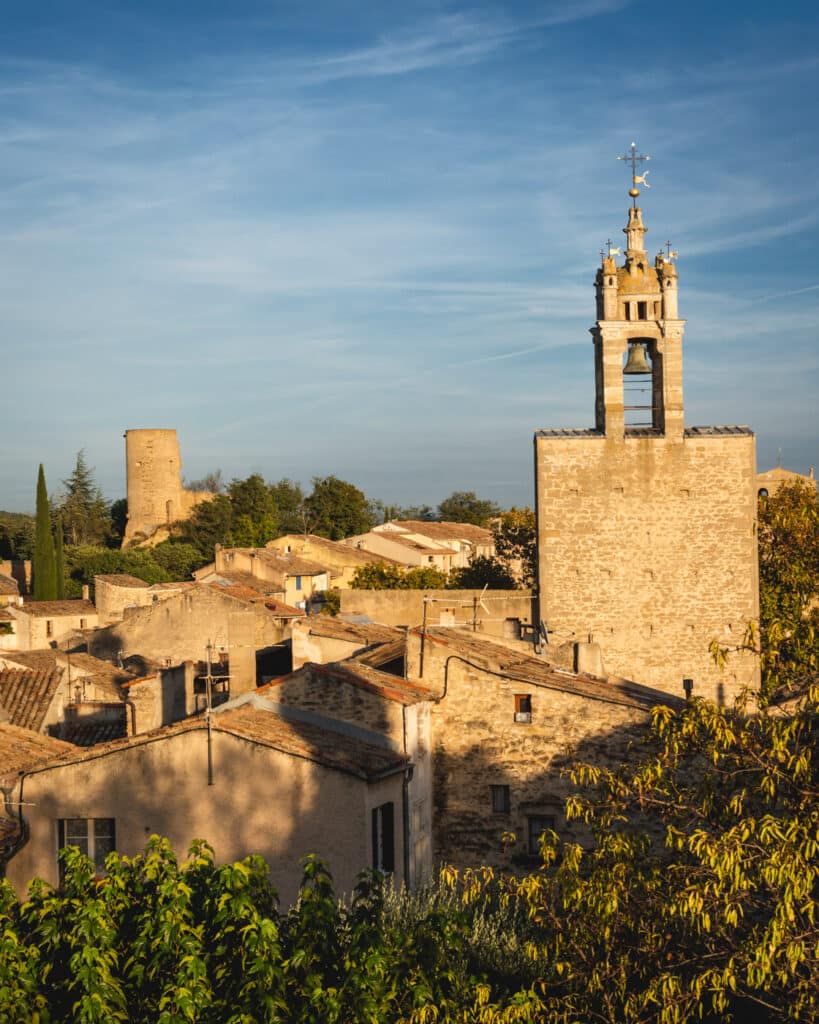
The belfry, built above a gate in the second line of ramparts, dates back to 1541. This gate lost its defensive purpose after the construction of the third line of walls.
It is topped by a bell tower, whose small turret supports a cross. Beneath this cross, an ornament could once be seen, shaped rather like an insect.
Local elders used to say, with a touch of humour, that it was a “barbarota”: a weevil that would settle in the granaries. Its symbolic presence at the top of the bell tower was believed to protect the cereal harvests.
Marc Deydier Museum


The Cucuron Museum is housed in a 17th century townhouse, the Hôtel des Bouliers. It was founded in 1970 through a joint initiative by a local association and the municipality. It is dedicated to Marc Deydier, a self-taught man, notary, photographer and prehistorian (1845-1920). His archaeological collections showcase remains from Neolithic and Bronze Age civilisations. The Roman period is represented by artefacts from a Roman villa and the mausoleum of an aristocratic Gallo-Roman family. Several local ethnographic rooms are dedicated to life in Cucuron around the 1900s.
The “Sus-Pous” Tower

This tower formed part of the third line of defensive walls. Built at the top of a mound, it became part of the Citadel during the Wars of the League in the 16th century.
The ramparts, known as barris in Provençal, were built over several different periods. The first enclosure surrounded the Saint-Michel mound, where the former seigneurial castle once stood. Dating from the 11th century, no trace of it remains today.
The second enclosure dates from the 12th and 13th centuries and still supports the districts of Mourre Frès, to the north, and Cousto Caudo, to the south.
The third enclosure, built in the period leading up to the Wars of Religion, is the best preserved. It includes the Portail de l’Étang, the Ginous Gate and the “Sus-Pous” Tower.
Generations of young people from Cucuron wore out the seats of their trousers on the steep slopes of this resquiau — a Provençal word meaning “slide”.
La Glacière
On the left, in front of the rampart, you can see the ruins of a round building. These are the remains of an “ice house”, once used to store blocks of ice in Cucuron.
Ice was used to treat bleeding, soothe pain and stomach aches, and reduce bruising. It also helped preserve food, especially Mediterranean fish that had been neither salted nor smoked.
Ice houses were ingeniously built into the slope of the land, with access doors at different levels so that ice could be both loaded in and removed. They also had two or three narrow openings, similar to arrow slits, to provide a little light and slight ventilation.
They were covered with a conical roof of rounded tiles and, like the walls, were carefully insulated with layers of earth, wood shavings and straw. Ice could be stored there for at least two consecutive years.
Although buried, the lower part was drained by a small channel that carried away meltwater, sometimes towards a small well.
During periods of severe cold, the water in Cucuron’s Étang basin froze for only a few days each year, so the ice had to be harvested very quickly.
Thanks to its excellent interior insulation and the mass of stored ice, the ice house maintained a very low temperature, even in the hottest summer months, keeping the ice perfectly preserved.
The Portail de l’Étang

At the bottom of the street, we come to the Portail de l’Étang, built in 1541 and formerly known as the “Porte de la Burlière”, after the neighbouring district.
In Provençal, burlière refers to a place where people played bowls. This is one of the two surviving gates of the 16th-century fortifications.
The openings through which the chains of the drawbridge once passed can still be seen. This gate played an important role during the Wars of Religion.
Market days and local flavours

The weekly market takes place all year round, every Tuesday morning, around the lake. Don’t miss the farmers’ market either, held on Thursdays from 5pm to 7pm around the lake, from May to October.
In Cucuron, you’ll find no shortage of excellent restaurants, starting with that of Chef Eric Sapet, awarded a Michelin star in the Michelin guide: La Petite Maison de Cucuron. Once a bar on the square in Cucuron, La Petite Maison has retained its welcoming spirit, inviting you to discover playful and inventive market-fresh cuisine, where the finest seasonal produce preserves the Provençal flavours of days gone by.
Not far from the village centre lies the estate of La Provence en Bouteille, where Virginie and Benjamin Maurizot grow organic ‘lavandin‘, or lavender phenomenal, and other plants to produce essential oil, as well as to make delicious syrups. In addition to the lavender fields, they also cultivate the black Provence truffle, the Tuber Melanosporum, which finds its way into the kitchens of top chefs and onto the plates of discerning food lovers. In season, don’t miss the chance to enjoy a delicious ice cream from Anne-Sophie, the renowned ice-cream maker of Cucuron, while sitting on the terrace or by the edge of the lake.

Cucuron’s history reveals itself as you wander through its narrow streets: ramparts, keep, citadel, private mansions and, from square to square, the living presence of fountains and wash houses. These places also preserve the memory of everyday scenes captured in photographs at the dawn of the 20th century.
Three walking trails are available in the heart of the village, inviting visitors to discover its heritage: the historic heritage trail, this water trail, and Marc Deydier’s “Cucuron in 1900” trail.
Love our villages?
Set off to discover the other villages of the South Luberon! Just 30 minutes from Aix-en-Provence, visit these charming, characterful, flower-filled villages.
Across the plains, unusual and authentic treasures await you in every village. Between vineyards, forest and lavender fields, the villages of the South Luberon never cease to surprise and enchant, bearing the marks of time through their impressive castles and ramparts — remnants of a bygone era, yet also of an art of living passed down from generation to generation.

Love our villages ? Visit the other villages of South Luberon! Just 30 minutes from Aix-en-Provence, explore these charming, flower-filled […]

Love our villages ? Discover more in the South Luberon! Just 30 minutes from Aix-en-Provence, explore charming, flower-filled villages full […]

If ever a village deserved its ‘Aigues’ name, it is surely this one. The word ‘Aïgue’ or ‘Aygue’ is the French adaptation of terms from Provençal, themselves derived from the Latin aqua, meaning ‘water’. Indeed, the village is crossed by four rivers and lies on the edge of the Étang de la Bonde, the largest lake in the department. Nestled in a haven of greenery and surrounded by broom in June, La Motte d’Aigues is a charming, peaceful little village with picturesque lanes and beautiful manor houses. Take the time to explore it on foot, whether during a walk or simply by stopping when you pass through.

Peypin d’Aigues is not limited to just the village. It stands out from the others thanks to the architectural wealth of its stone hamlets and the vastness of its forest massif, from which numerous streams flow down. Peypin d’Aigues takes its name from Podium Pini, of Roman origin, with the root Pey referring both to stone and to a rocky summit. The suffix Pini conjures up the image of a pine forest clinging to the slopes of this stony hill. There used to be pine trees everywhere here! Relax in the pleasant Place de la Fontaine, then enjoy the coolness of its botanical trail for a nature walk.