
Nestled on the banks of the Durance River, in the heart of Provence, the squares of the village of Mirabeau are worthy of a theatre set. This village is a true Provençal icon, as it was here that ‘Manon of the Spring’ was filmed, a Franco-Swiss-Italian drama directed by Claude Berri, released in 1986. Steeped in history and beloved by many, this sun-drenched spot is sure to captivate you with its breathtaking views (hence its name, meaning ‘beautiful view’ or ‘to see what is beautiful’).

Mirabeau, in the footsteps of Manon of the Spring
Mirabeau is a beautiful village with Provençal charm that will delight you as you stroll through the Luberon! Its location is perfect for a relaxing and, above all, rejuvenating nature holiday.

Everything here feels like a story waiting to be discovered. The monumental bridge, where architectural details bear witness to the fascination with the Durance River, so gentle in appearance, yet capable of sudden, dramatic surges.

The Pont de Mirabeau, sharing its name with the one in Paris, has had a turbulent history. The first attempt to build a bridge dates back to the 15th century. The various ‘Pont de Mirabeau’ that were built were destroyed, either wholly or in part, on four occasions by the raging Durance River. Each time, it was rebuilt, as its toll was profitable. The piers of the former suspension bridge date back to 1832. The suspension cables are anchored to two immense neo-Romanesque gateways, still standing today (listed on the supplementary inventory of Historic Monuments in 1988).
The château itself was built at the end of the 16th century by Jean Riqueti and enhanced over the next two centuries, combining the imposing presence of fortifications with the charm of 18th-century residences. It was home to Victor Riqueti de Mirabeau, Marquis de Mirabeau, writer, philosopher and economist, and his son, Gabriel Honoré, Count of Mirabeau, orator, pamphleteer and conspirator. His great-grandniece Sibylle Gabrielle Riquetti de Mirabeau, Countess of Martel, known in literature as Gyp, bought the Château de Mirabeau in 1895, where she undertook major works that ruined her. She was forced to sell it in 1907 to Maurice Barrès.

Mulberry trees were planted in Mirabeau for silk production. But what is remarkable is that, alongside the silkworm-rearing houses which required premises, space and staff, this agricultural practice also attracted even the poorest families. The poverty in certain regions, including South Luberon, led residents to seek additional sources of income. Silkworm farming required only a small amount of land and labour (40 days a year, in spring), and the value of the product was relatively high. What’s more, the whole family could get involved: men picked the leaves, while women and children fed the silkworms (three times a day, and only with mulberry tree leaves). The elders recall that women used to keep the eggs in their bodices, maintaining a constant temperature to allow them to hatch. It’s easy to understand why this resource was so cherished! Even better, farms always had attic corners, storage rooms and forgotten spaces where silkworms could be raised.
Sights and heritage of Mirabeau
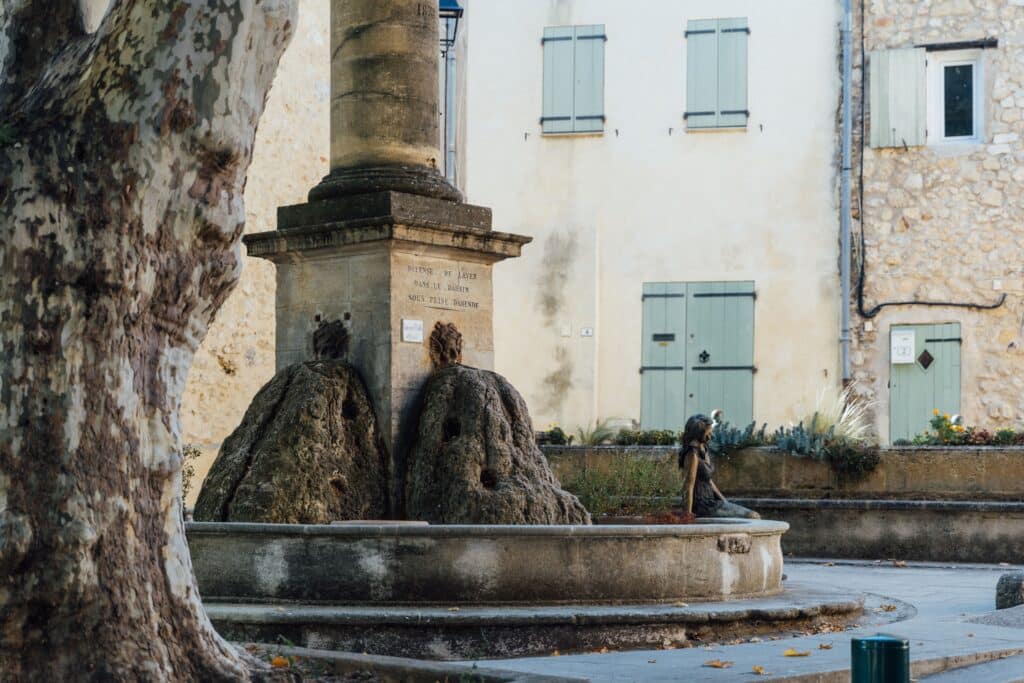
Place de la Fontaine in Mirabeau
The fountain has a circular basin adorned with spouting tritons. As the water is rich in limestone, the moss growing from the tritons gradually turns into tufa (a soft stone), flowing down like a stream of lava. For the filming of the movies ‘Manon of the Spring’ and ‘Jean de Florette’, the tufa was carefully removed and then replaced afterwards.
In the village of Mirabeau, you will discover a beautiful statue of Manon, created by an artist from Cucuron, Jean-Jacques Mancardi, unveiled in July 2018. To immortalise the scene with Manon, the commune of Mirabeau wished to commemorate the event by installing a bronze statue of Manon seated on the edge of the fountain of discord, whose water no longer flows because Manon blocked the spring upstream in the mountains. Today, the fountain still stands in this square and its water flows.
Le Château
Overlooking the village, the hilltop Château of Mirabeau fascinates visitors with its beauty and grandeur. Only its pale green shutters hint at its renovation.
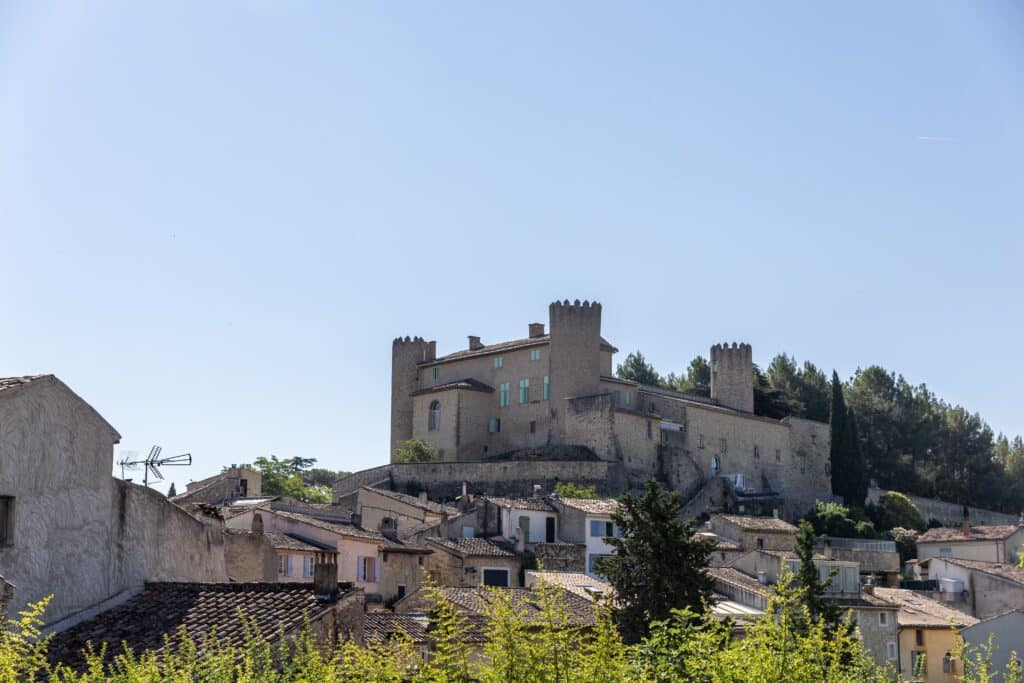
Today, it is a private property, not listed as a historic monument, and is not open to visitors. However, once a year, the owners open the château courtyard to the general public for a musical evening.
This exceptional event usually takes place during the Durance Luberon Festival in August. Don’t miss this opportunity to discover more about this still little-known heritage site!
Sainte Madeleine du Pont Chapel

The Sainte Madeleine du Pont de Mirabeau Chapel overlooks the Durance River. It was built to protect those wishing to cross to the other bank. Its architecture is very traditional: a two-bay nave, a barrel-vaulted ceiling, and a semi-circular apse. The numerous holes marking its façade were used to install a canopy designed to shelter pilgrims. The floor of the church is the bare rock itself, with shallow foundations.
What to do in Mirabeau
Discover the Château de Clapier
Château de Clapier, on the road to Manosque, was once the former hunting lodge of the Riqueti family. The name ‘Clapier’ refers to the locality, but its origin can also be traced to the Provençal word ‘clapas’, meaning a pile of stones. It is now a Luberon AOC wine estate, where you can discover their wine and 12 monumental wine tanks, each over a hundred years old and capable of holding up to 24,000 litres of wine. You can also explore the estate with a free treasure hunt!
Le Relais du Grand Logis
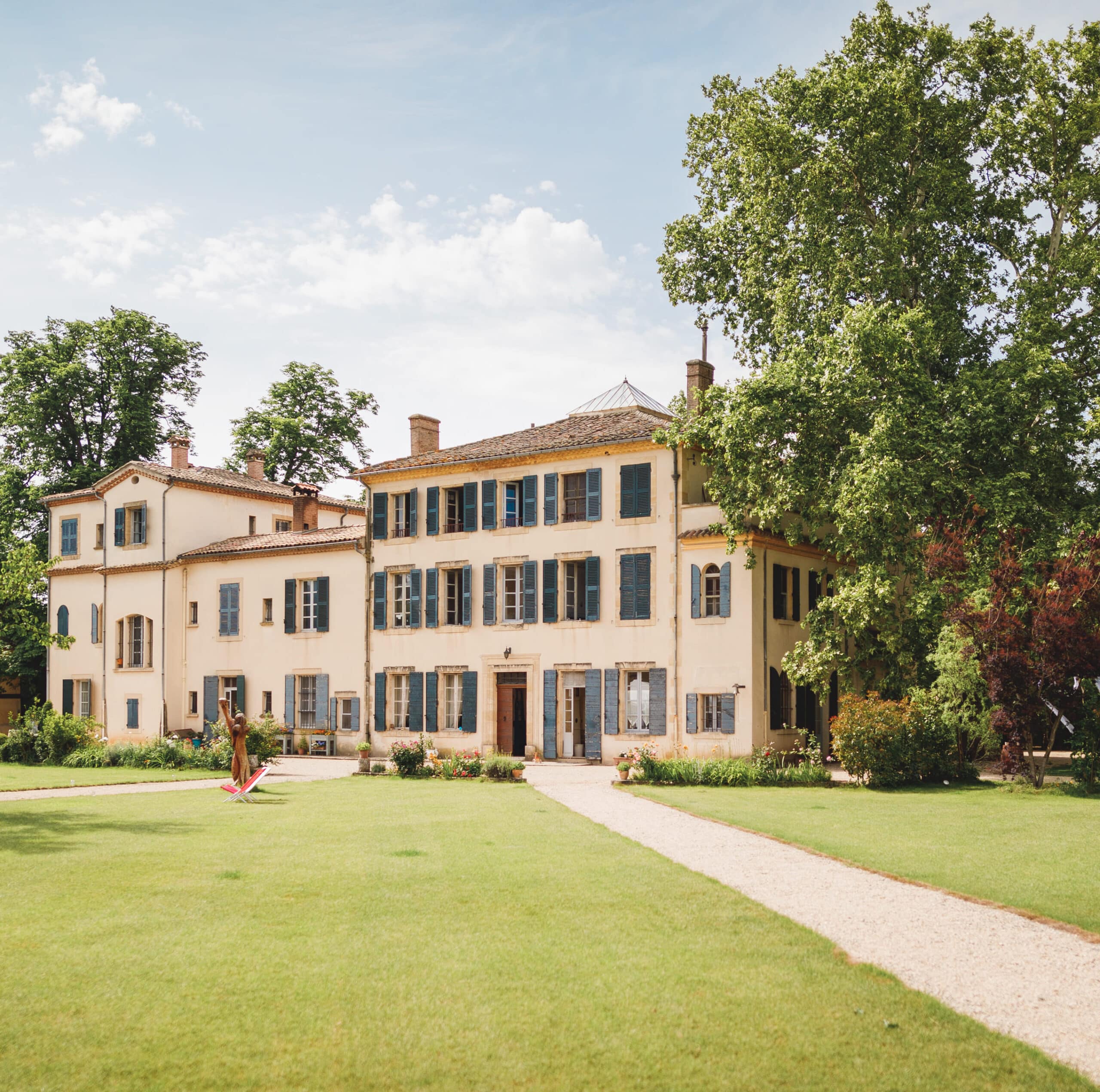
Many periods in the history of the Grand Logis remain to be clarified, but its important role as a post house on the Aix – Sisteron route has been known since the 16th century. Travellers and stagecoaches would stop here for a well-deserved night’s rest or to change horses before continuing on the road to the Alps or crossing the Durance River by means of the cable ferry. The central section, with its faux ashlar façade and main entrance to the right of the tower, served as an inn, with guest rooms located upstairs, while the building on the east side saw stagecoaches coming and going along the edge of the old road. On the west side, the large vaulted hall was once the stables where the horses were kept, with the hayloft situated just above. It was accessed through openings that are still visible today.
Located on the lands of the Marquis de Mirabeau, which were sold after the Revolution, the Grand Logis became, from 1880 onwards, a farm or an outbuilding of the wine estate of Château de Clapier until 1998, creating memories that still linger among the elders of the surrounding villages. In 2005, the project to renovate the building into gîtes (self-catering cottages) and bed and breakfast rooms was launched, and after three years of work, the Relais du Grand Logis once again became a haven for travellers. Do not hesitate to step inside; during your visit, you will discover an authentic atmosphere, as the soul of the house has remained untouched. Copies of the plans drawn up in 1885 are available for consultation on request.
Market day and local flavours
Don’t miss the weekly market in Mirabeau! It takes place every Thursday morning. Fruit, vegetables, meat, fish, flowers, local specialities, you’ll discover a wealth of local produce here.
Love our villages ?
Set off to discover the other villages of the South Luberon! Just 30 minutes from Aix-en-Provence, visit these charming, characterful, flower-filled villages.
Across the plains, unusual and authentic treasures await you in every village. Between vineyards, forest and lavender fields, the villages of the South Luberon never cease to surprise and enchant, bearing the marks of time through their impressive castles and ramparts, remnants of a bygone era, yet also of an art of living passed down from generation to generation.

Love our villages ? Set off to discover the other villages of the South Luberon! Just 30 minutes from Aix-en-Provence, […]

Peypin d’Aigues is not limited to just the village. It stands out from the others thanks to the architectural wealth of its stone hamlets and the vastness of its forest massif, from which numerous streams flow down. Peypin d’Aigues takes its name from Podium Pini, of Roman origin, with the root Pey referring both to stone and to a rocky summit. The suffix Pini conjures up the image of a pine forest clinging to the slopes of this stony hill. There used to be pine trees everywhere here! Relax in the pleasant Place de la Fontaine, then enjoy the coolness of its botanical trail for a nature walk.

Love our villages? Set off to discover the other villages of the South Luberon! Just 30 minutes from Aix-en-Provence, visit […]

Love our villages? Set off to discover the other villages of the South Luberon! Just 30 minutes from Aix-en-Provence, visit […]