
Stop off in the village of Villelaure and wander through a maze of narrow streets to discover a wealth of old houses, fountains, the church and its square, and an eighteenth-century château with its 3-hectare park, jewels of the South Vaucluse heritage. Located in the southern part of the Luberon in the Durance, plain, you will be charmed by its hiking and mountain biking trails, as well as its views of the Durance valley and the beautiful Luberon massif. Ideally located on the map, between Cadenet and Pertuis, you will find yourself nestled in an exceptional setting.

The grounds of Château Verdet – Kléber
Don’t expect to find a castle as such; in fact, it’s a manor house! The charming house in this village belonged to the Forbin de Janson family from 1745 to 1849. After the bankruptcy of the sugar factory at ‘la Fabrique’, the family was forced to sell their property to Mr Trone, a wealthy merchant from Aix, who bought it but then sold it again in 1860 to Mrs Verdet Kleber. The heirs sold the château in 1950 to the Sisters of St Vincent de Paul, who transformed it into a rest and holiday home for underprivileged children from the city of Avignon. Put up for sale in 1970, Château Verdet Kleber was purchased in 1977 by the canton of Villelaure. Today, the park is a lush haven for relaxation beneath the shade of the magnificent cedar, which is almost 200 years old!
Sights & Heritage of Villelaure

The Sugar Factory Gate
‘La Fabrique’ is a former industrial sugar factory built between 1832 and 1835 by Marquis Joseph II de Palamède de Forbin. The three-storey buildings form a square measuring 150 metres on each side. There were warehouses, accommodation for around a hundred workers, a manor house and a production unit for beet sugar, cereals, madder and thistles. The machines, powered by a diversion from the Villelaure canal and boasting a driving power of 100 horsepower, were considered exemplary at the time. After about ten years of production, the sugar factory declined; overworked soil and aphid infestations would hasten the marquis’s bankruptcy. He made make several attempts to produce cereals, madder, silkworms, and thistles, but without any real success. 1845 marked the beginning of the dismantling of the Forbin de Janson family estate. La Fabrique was divided up and gave rise to the present-day hamlet. Its gateway remains a magnificent testament to the historical heritage of Villelaure.
The Church and St Marc Fountain

At the corner of the ascent to the château stand two interlinked fountains. The oldest one retains its fountain back wall, adorned with pilasters and a moulded cornice (1819). St Marc Church, built between 1118 and 1123, reflects the history of Villelaure. Like the village itself, it was ransacked, destroyed, rebuilt, abandoned and later restored and enhanced. The exterior is remarkably understated. With the population growth in the 18th century, a new nave was built, extended by a choir, while the former nave became a side aisle.
After the collapse of the bell‑wall, a bell tower was built in the 19th century. Inside, the stained-glass windows come from the André d’Aix-en-Provence workshop. The stained glass window in the chancel depicts Saint-Marc.
The ‘Eiffel Tower’ Fountain
Adorned with a small stone Eiffel Tower, this might come as a surprise in the heart of Provence! In fact, it is a small tribute to the real Eiffel Tower, created for the 1889 Exposition Universelle in Paris.

Château of Reine Laure
The residence of the lords of Villelaure was originally a simple Bastide (country house), most likely built in the years following the repopulation of the village in 1512. An initial series of extensions carried out before 1563 gave the building larger proportions: the owner Melchior Forbin set out to transform this still modest residence into a true château in Villelaure, inspired by the château of La Tour-d’Aigues. A fountain and a dovecote were added shortly afterwards. The successors left the building to tenant farmers, who converted it into barns and stables. The old residence was restored after a fire in the 16th century caused by the Waldensian troops who came in retaliation; in 1560, Lord Gaspard de Forbin transformed and extended the building. To this day, it remains a private property undergoing renovation and is not open to visitors.
A night in a place steeped in history: La Ferme Hi Bride
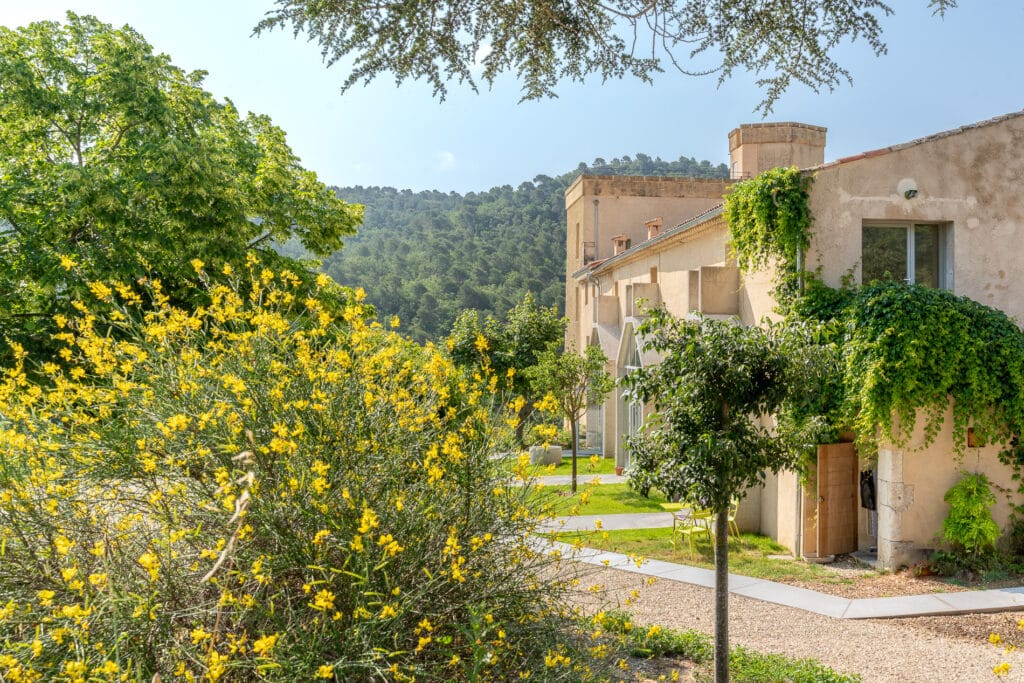
Perched above Villelaure, nestled among the hills of South Luberon, Domaine La Ferme Hi Bride is much more than a guest house: it is a place where medieval heritage meets contemporary design.
The estate, boldly restored by Patrick El Ouarghi and Philippe Chapelet, in collaboration with designer matali crasset, stretches across 20 unspoilt hectares. Here, old and new coexist in perfect harmony: natural stone, light wood, vaulted ceilings and abundant light create a refined yet understated atmosphere.
At the heart of the site, the Tour de Ferrier, dating back to the 12th century, still watches over the valley. This medieval relic, now part of the estate, is thought to have served as a watchtower overseeing the surrounding area, particularly in connection with the defence of the Château d’Ansouis, located nearby. It has been carefully restored, and now welcomes visitors into a unique atmosphere, blending authenticity with comfort.
Just a few steps away, the former irrigation basin, once essential to the farm, has been transformed into a swimming pool. A stylish nod to the site’s agricultural heritage, now offering a refreshing escape with views over the Luberon hills.
Minimalist rooms with panoramic terraces, locally sourced cuisine from the kitchen garden, wellness retreats, artist residencies… Every detail is designed to offer an immersive experience, blending tranquillity, beauty and the spirit of the place.
What to do in Villelaure


Enjoy the experiences offered by the Village de Gîtes de l’Oustaou du Luberon: meditation, wellness workshops, culinary stays, cycling holidays and zen getaways await you! Electric bikes are available for rent and a farm shop is open to the public. Michel and Cécile are here to help you create your tailor-made stay. An ideally located spot in the heart of nature, surrounded by professionals who put people at the heart of what they do.
For animal and adventure lovers, don’t miss the chance to experience a mini-safari by 4×4 in the ostrich park in Villelaure. Ostriches, greater rheas, and emus will no longer hold any secrets for you! Take advantage of this unique area to fish for your own catch and head home with your dinner! Then, finally, to recharge your batteries, stop off at the Domaine des Jardinettes, where you can buy and taste organic wines. A wealth of activities awaits you in Villelaure!
Market days and local flavours


Don’t miss the chance to discover seasonal produce at the farmers’ markets of the Luberon. These are places brimming with colour and fragrance! Every Saturday morning on Rue Forbin de Janson, all year round. Don’t miss the much-loved farmers’ market, a favourite with locals, held on Mondays from 5pm to 7pm at Ferme de la Chevalière, from May to October.
Enjoy delicious pizzas on site at Casa Pizza Villelaure and fresh fruit and vegetables from local producers at Cathy Fruits and Ferme de la Chevalière. At the foot of the Luberon, the Auberge la Bastide Neuve is set within a farmhouse whose architecture is typical of the late 19th century. For 27 years, its welcome has remained true to the tradition of rural hospitality. This is an unmissable place if you want to savour authentic Provençal cuisine in a warm, family setting.
Love our villages ?
Set off to discover the other villages of the South Luberon! Just 30 minutes from Aix-en-Provence, visit these charming, characterful, flower-filled villages.
Across the plains, unusual and authentic treasures await you in every village. Between vineyards, forest and lavender fields, the villages of the South Luberon never cease to surprise and enchant, bearing the marks of time through their impressive castles and ramparts, remnants of a bygone era, yet also of an art of living passed down from generation to generation.

Love our villages? Set off to discover the other villages of the South Luberon! Just 30 minutes from Aix-en-Provence, visit […]

Love our villages ? Discover more villages in the South Luberon! Just 30 minutes from Aix-en-Provence, explore charming, flower-filled villages […]

Love our villages ? Set off to discover the other villages of the South Luberon! Just 30 minutes from Aix-en-Provence, […]

Love our villages ? Visit the other villages of South Luberon! Just 30 minutes from Aix-en-Provence, explore these charming, flower-filled […]